Yu Sleep Reviews: What These Low-Melatonin Sleep Drops Contain and What to Realistically Expect
By the Natural Routine Editorial Team · Updated October 2026
Disclosure: this article contains affiliate links. If you buy through them, we may earn a commission at no extra cost to you. It does not change what we write.
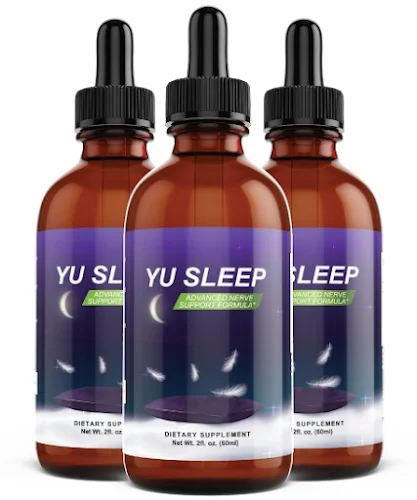
Yu Sleep at a Glance
| Form | Liquid drops — 2 droppers held under the tongue about 30 minutes before bed (2 fl oz / 60 ml bottle) |
| Core ingredients | 10: melatonin 0.9 mg, tart cherry, magnesium glycinate, L-theanine, GABA, apigenin, lemon balm, 5-HTP, vitamins B6 and B2 |
| Made in | Not stated on the official website |
| Guarantee | 60 days from purchase; the refund policy says about 85% is refunded and return postage is yours |
| Shipping (US) | Added on the 2-month package; free on 3- and 6-month packages; about 5-7 business days |
| Main caution | Contains 5-HTP and melatonin — talk to a doctor if you take antidepressants, sedatives or other sleep medicines |
Bad sleep rarely arrives all at once. First it takes a little longer to drift off, then you start waking at 2 or 3 a.m. with a busy mind, and after a while even a full night in bed leaves you groggy. About a third of American adults say they regularly get less sleep than they need, so it is no surprise that sleep supplements are one of the busiest corners of the supplement aisle.
Yu Sleep is one of the newer names in that space. It is sold online as a liquid you hold under the tongue, and its main hook is a deliberately low dose of melatonin (0.9 mg) mixed with nine other ingredients such as tart cherry, magnesium, L-theanine and GABA. Below we look at what is in the bottle, how much of the marketing holds up, what each ingredient has and has not been shown to do, who should be careful, and exactly what the price and refund terms say.
→ See the full Yu Sleep formula on the official website
What Is Yu Sleep?
Yu Sleep is a dietary supplement for adults who want nutritional support for falling asleep and staying asleep. It comes in a 2 fl oz (60 ml) amber bottle with a dropper. The official directions are simple: two full droppers about 30 minutes before bed, squeezed under the tongue and held for around thirty seconds before swallowing. At that rate one bottle covers roughly a month.
The sales page credits the formula to a "Dr. Collins" and describes the liquid as nano-emulsified, saying it is absorbed better than a capsule. The label on the bottle itself carries the tagline "Advanced Nerve Support Formula", which hints at the calming, wind-down angle of the blend rather than a heavy sedative effect.
Several basic facts are not stated on the official site: the country of manufacture, whether the product is made in an FDA-registered or GMP facility, and the amount of each ingredient other than melatonin. Yu Sleep is also sold only in packages of two months or more, so there is no single-bottle trial option.
As with every dietary supplement, the FDA does not review Yu Sleep for effectiveness before it is sold, and the site carries the standard disclaimer that its statements have not been evaluated by the FDA and that it is not meant to diagnose or address any disease.
How Yu Sleep Is Said to Work: Claims vs Evidence
The brand's explanation centers on "sleep pressure" — the build-up of a brain chemical called adenosine during waking hours, which makes us progressively sleepier until we go to bed. The sales page argues that modern habits weaken this system and that Yu Sleep helps rebuild it, while the small melatonin dose tells the body that night has arrived. It also connects better sleep to fewer late-night carb cravings and more daytime energy.
Here is how those ideas stack up:
- Sleep pressure is real. Adenosine build-up is a well-established part of sleep science. What is not established is that any supplement "restores" it; there is no published study showing this formula changes adenosine signaling.
- Low-dose melatonin is a reasonable choice. Research going back to the 1990s found that doses well under 1 mg can be enough to shorten the time it takes to fall asleep, and smaller doses tend to cause less next-day grogginess than the 5 or 10 mg tablets common in pharmacies.
- The absorption claims are unproven for this product. Holding a liquid under the tongue is a legitimate way to take some compounds, but the brand does not publish absorption data for Yu Sleep itself.
- No trial of the finished formula is cited. The 20 scientific references on the sales page concern individual ingredients, not Yu Sleep. Large numbers such as review counts on the page are brand statements we cannot verify.
In short, the product is better judged by its ingredients than by its story. That is what the next section does.
Yu Sleep Ingredients and What the Research Says
The official page names ten ingredients but publishes the dose of only one, melatonin. Without the other amounts, we cannot say whether each ingredient is present at the levels used in studies, which is a common limitation in this category.
1. Melatonin (0.9 mg)
Melatonin is the hormone the brain releases in the evening to signal that it is night. A 2013 meta-analysis of trials in people with primary sleep disorders found it shortened the time to fall asleep by about seven minutes on average and slightly increased total sleep time — a real but modest effect. The NIH's National Center for Complementary and Integrative Health (NCCIH) describes it as most useful for jet lag and sleep-timing problems. At 0.9 mg, Yu Sleep sits in the low range that tends to be gentler the next morning.
2. Tart Cherry Extract
Montmorency tart cherries contain small amounts of natural melatonin and polyphenols. Two small studies are often cited: one in older adults with insomnia that found a modest gain in sleep time with tart cherry juice, and one in healthy adults that found higher melatonin levels and slightly longer sleep. Both used juice concentrate, not an extract of unknown dose, and both were short.
3. Magnesium Glycinate
Magnesium is an essential mineral involved in nerve and muscle function, and the glycinate form is generally gentle on the stomach. A small 2012 trial in older adults with insomnia reported better sleep measures with magnesium, but overall human evidence is limited and mixed. The NIH Office of Dietary Supplements notes that most people can meet their needs through food; extra magnesium may matter most for those who run low.
4. L-Theanine
L-theanine is an amino acid found in tea leaves. Randomized trials, including a 2019 four-week study in healthy adults, have reported improvements in stress-related symptoms and some sleep-quality scores without daytime sedation. Effects are usually mild, and the doses studied (around 200 mg) may or may not match what is in a few droppers of liquid.
5. GABA
GABA is the brain's main calming messenger. Whether GABA taken by mouth crosses into the brain in meaningful amounts is still debated. A handful of small studies, some combining GABA with L-theanine, reported a shorter time to fall asleep, but the research is early and partly industry funded.
6. Apigenin
Apigenin is the plant compound most associated with chamomile's reputation as a bedtime drink. It binds to the same brain receptors targeted by some anti-anxiety drugs in laboratory studies. NCCIH notes that human evidence for chamomile and sleep is limited, and isolated apigenin has very little human research of its own.
7. Lemon Balm Extract
Lemon balm is a mint-family herb used for centuries to promote calm. Small human studies suggest it may ease mild anxiety and restlessness, often when combined with valerian or other herbs, which makes its individual contribution hard to isolate.
8. 5-HTP
5-HTP is a building block the body uses to make serotonin, which is later converted to melatonin. Sleep studies in healthy adults are scarce. The bigger issue is safety: 5-HTP raises serotonin, so it should not be combined with antidepressants, triptans or other serotonin-raising drugs without medical advice. This is the ingredient that most deserves attention before you order.
9. Vitamin B6
Vitamin B6 helps the body produce neurotransmitters, including serotonin and melatonin. A 2018 study found that B6 taken before bed improved dream recall in some people. There is little evidence that extra B6 improves sleep in people who already get enough from food.
10. Vitamin B2 (Riboflavin)
Riboflavin is involved in energy metabolism. Observational data has linked B2 intake to sleep patterns, but there are no solid trials showing that supplementing it improves sleep in people who are not deficient.
Prefer drops to pills and a gentler melatonin dose? Check Yu Sleep's current packages on the official site.
Visit the Official Yu Sleep Website →Pros and Cons of Yu Sleep
Pros
- Low 0.9 mg melatonin dose, gentler than many 5-10 mg pharmacy products
- Liquid drops — no capsules to swallow
- All ten ingredients are named on the sales page
- Several ingredients (melatonin, tart cherry, L-theanine) have at least some human research
- 60-day money-back guarantee and free shipping on 3- and 6-month packages
Cons
- Doses are published for melatonin only
- No clinical trial of the finished formula is cited
- Contains 5-HTP, which interacts with common antidepressants
- Minimum purchase is a 2-month package ($138 plus shipping)
- Refund policy returns about 85% of the price, not the full amount, and only once per customer
- Country of manufacture and facility standards are not stated
Who Might Consider Yu Sleep (and Who Should Not)
Yu Sleep is aimed at healthy adults who:
- have occasional trouble winding down or falling asleep, rather than a diagnosed sleep disorder
- want to try a lower melatonin dose than typical drugstore tablets
- prefer a liquid over capsules
- are already working on basic sleep habits — a regular bedtime, a dark room, less caffeine and fewer late screens
It is not a good fit without a doctor's input if you:
- take antidepressants (SSRIs, SNRIs, MAOIs), triptans, tramadol or other serotonin-raising drugs
- use sleeping pills, benzodiazepines, opioids or other sedating medicines
- take blood thinners, blood pressure medicines, diabetes medicines or immunosuppressants, which melatonin can affect
- are pregnant, breastfeeding or under 18
- have epilepsy, depression, bipolar disorder or another mental health condition
- snore loudly, stop breathing at night or feel very sleepy during the day — possible signs of sleep apnea, which needs medical care
Long-lasting insomnia (three nights a week for three months or more) deserves a medical evaluation. The American College of Physicians recommends cognitive behavioral therapy for insomnia (CBT-I) as the first-line approach, ahead of any pill or supplement.
Safety and Side Effects
No serious side effects have been publicly reported for Yu Sleep as a finished product, and the official site does not publish a side-effect profile. Based on its ingredients, the most likely issues are mild: morning grogginess, headache, dizziness, vivid dreams or an upset stomach. Low-dose melatonin is generally well tolerated in short-term use, according to NCCIH.
The cautions that matter most are interactions. 5-HTP combined with serotonin-raising medicines can, in rare cases, contribute to serotonin syndrome. Melatonin, GABA, L-theanine and lemon balm can add to the effect of sedatives and alcohol. Do not drive or operate machinery after taking it, avoid mixing it with alcohol, and try your first dose on a night when you can sleep in. If you take any regular medication, show the ingredient list to your pharmacist before starting.
How to Use Yu Sleep
Take two full droppers about 30 minutes before bed. Place the liquid under your tongue, hold it for about thirty seconds, then swallow. The brand's refund page asks users to take it every night for at least 21 nights in a row before judging, and says most people notice changes somewhere between weeks two and four.
To get a fair read, keep a simple sleep diary: bedtime, roughly how long it took to fall asleep, how many times you woke up and how rested you felt. Pair the drops with consistent sleep habits, since no supplement can outrun late caffeine, an irregular schedule or a bright phone in bed.
Yu Sleep Price, Shipping and Guarantee
Yu Sleep is sold in three packages on the official website. There is no single-bottle option; the smallest order covers two months.
| Package | What the official site states |
|---|---|
| 2-month supply (2 bottles) | $138 total ($69 each) + shipping |
| 3-month supply (3 bottles) | $177 total ($59 each), free US shipping, bonuses included |
| 6-month supply (6 bottles) | $294 total ($49 each), free US shipping, bonuses included |
| US delivery | About 5-7 business days via UPS; tracking email within 3 business days |
| US shipping fee (2-month) | Listed as $14.95 in one place and $9.95 in another — confirm at checkout |
| Canada | $29.95 shipping, about 14-21 business days |
| Guarantee | 60 days from purchase |
The bonuses on the larger packages are digital: a collection of bedtime audio stories and two eBooks. Payment is a one-time charge on the official order page; no subscription is mentioned.
→ Check today's Yu Sleep price and packages on the official website
Refund Policy: What the Sales Page Says vs What the Fine Print Says
This is the part most reviews skip, and it is worth reading before you pay. The sales page FAQ describes the 60-day guarantee in broad, "every penny back" terms. The separate refund policy page is more specific:
- you have 60 days from purchase to request a refund by emailing support with your name, order number and receipt, and stating exactly which bottles you are returning;
- bottles go back to a fulfillment address in Aurora, Colorado, with your order number on a note inside the package, and you send support the tracking number;
- shipping and handling are not refundable, and the policy says refunds are issued at around 85% of the purchase price;
- return postage is paid by you;
- the guarantee applies once per customer — if you get a refund and later buy again, the second order is not refundable.
None of this is unusual for products sold this way, but it means the guarantee lowers your risk rather than removing it. Save your receipt email and delivery date, and decide by around day 50 so the return can be posted in time.
What We Saw on the Official Yu Sleep Order Page (October 12, 2026)
On October 12, 2026 we opened the official order page ourselves and followed the checkout up to the payment step, without placing an order, to record exactly what a buyer sees. The screenshots below are unedited crops from that visit.
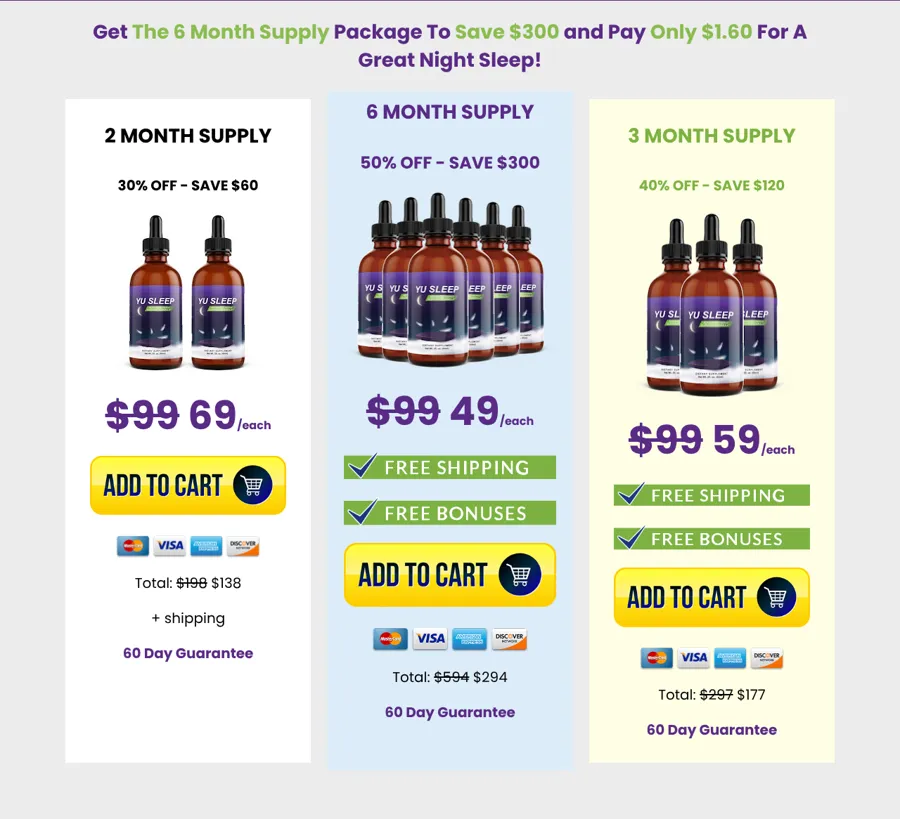
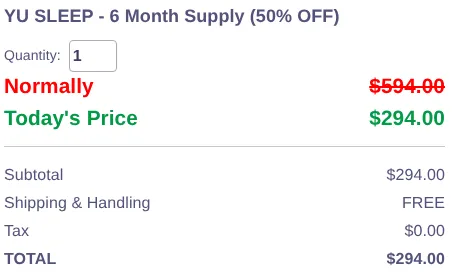
- The order page offered the 2-month supply at $69 per bottle ($138) plus shipping, the 3-month supply at $59 per bottle ($177) and the 6-month supply at $49 per bottle ($294), the larger two with free shipping.
- The 6-month checkout showed $294.00 with free shipping and $0.00 tax, and its header stated a one-time fee with no autoship.
- The refund policy page gives 60 days after purchase. Contact address listed: support@yu-sleep.com.
Yu Sleep vs Regular Melatonin Tablets
A fair comparison is a plain low-dose melatonin tablet from a pharmacy, which typically costs a few dollars a month. Yu Sleep costs $49-$69 a month. What the extra money buys is the liquid format and nine additional ingredients aimed at relaxation. If melatonin alone has never helped you, a combination formula may be worth a look; if you have never tried melatonin at all, starting with a simple low dose is the cheaper experiment. Anyone on serotonin-related medication may actually be better served by a product without 5-HTP.
Where to Buy Yu Sleep
Yu Sleep is sold through its official website. Bottles on marketplaces or from unknown sellers may be old stock or imitations and are unlikely to be covered by the 60-day guarantee. Ordering from the official order page is the only way to be sure the refund policy applies to your purchase.
Final Verdict
Yu Sleep does a few things right. It uses a sensible low dose of melatonin, it names every ingredient, and its liquid format suits people who dislike pills. Melatonin, tart cherry and L-theanine have at least modest human evidence behind them, and the overall approach — gentle relaxation support rather than a knock-out sedative — is reasonable.
The weak points are the undisclosed doses for nine of the ten ingredients, the absence of any study on the product itself, a sales page that promises more than the science can show, and refund terms that return about 85% rather than the full price. The 5-HTP content also rules it out for many people on antidepressants. If your doctor or pharmacist sees no conflict with your medications and you commit to the suggested 21 nights alongside good sleep habits, Yu Sleep is a reasonable product to try. Keep expectations realistic: supplements can support sleep, but they do not fix chronic insomnia or sleep apnea.
Frequently Asked Questions (FAQs)
How much melatonin is in Yu Sleep?
The official site states 0.9 mg per serving of two droppers. That is lower than many store-bought melatonin products, which often contain 3 to 10 mg.
How long does Yu Sleep take to work?
The brand asks users to take it nightly for at least 21 nights in a row and says most people notice changes between weeks two and four. Melatonin itself can act on the first night, but the other ingredients have been studied over several weeks.
Can I take Yu Sleep with antidepressants?
Ask your doctor first. Yu Sleep contains 5-HTP, which raises serotonin and may interact with SSRIs, SNRIs, MAOIs and some migraine drugs. Melatonin and GABA can also add to the effect of sedatives.
Is Yu Sleep FDA-approved?
No dietary supplement is FDA-approved. The official site does not state where Yu Sleep is made or whether the facility is FDA-registered.
Does Yu Sleep have side effects?
No serious side effects have been publicly reported. Possible mild effects include morning grogginess, headache, dizziness, vivid dreams or stomach upset. Avoid alcohol and driving after taking it.
What does the Yu Sleep refund policy actually return?
You have 60 days from purchase. The refund policy says shipping and handling are not refundable, refunds are about 85% of the price, return postage is yours, and the guarantee applies only once per customer.
Can I buy just one bottle of Yu Sleep?
No. The smallest package on the official site is a 2-month supply (two bottles) for $138 plus shipping.
Want to see today's Yu Sleep packages and bonuses? The official site shows current prices.
Visit the Official Yu Sleep Website →References
- NCCIH (National Center for Complementary and Integrative Health). Melatonin: What You Need To Know.
- Ferracioli-Oda E, Qawasmi A, Bloch MH. Meta-analysis: melatonin for the treatment of primary sleep disorders. PLoS One. 2013;8(5):e63773.
- Zhdanova IV, et al. Sleep-inducing effects of low doses of melatonin ingested in the evening. Clin Pharmacol Ther. 1995;57(5):552-558.
- Pigeon WR, et al. Effects of a tart cherry juice beverage on the sleep of older adults with insomnia: a pilot study. J Med Food. 2010;13(3):579-583.
- Howatson G, et al. Effect of tart cherry juice (Prunus cerasus) on melatonin levels and enhanced sleep quality. Eur J Nutr. 2012;51(8):909-916.
- Abbasi B, et al. The effect of magnesium supplementation on primary insomnia in elderly: a double-blind placebo-controlled clinical trial. J Res Med Sci. 2012;17(12):1161-1169.
- Hidese S, et al. Effects of L-theanine administration on stress-related symptoms and cognitive functions in healthy adults: a randomized controlled trial. Nutrients. 2019;11(10):2362.
- Kim S, et al. GABA and l-theanine mixture decreases sleep latency and improves NREM sleep. Pharm Biol. 2019;57(1):65-73.
- NIH Office of Dietary Supplements. Magnesium — Fact Sheet for Health Professionals.
- NCCIH. Chamomile — Usefulness and Safety.
- Qaseem A, et al. Management of chronic insomnia disorder in adults: a clinical practice guideline from the American College of Physicians. Ann Intern Med. 2016;165(2):125-133.
This review is for general information only and is not medical advice. Product details (ingredients, prices, guarantee) come from the official Yu Sleep pages as checked in October 2026; they can change, so confirm them at checkout. Talk to your doctor before starting any supplement, especially if you take prescription medication or have a health condition.